History
Brief History of the University of Arkansas Department of Entomology
Entomology was a discipline area in the very beginning of the state's land-grant university,
and in many ways the department 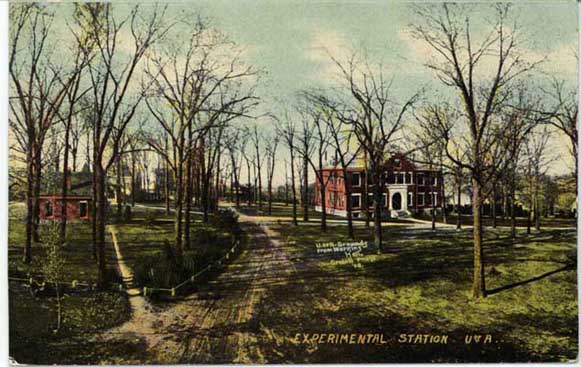 reflects the changing focus and maturity of the university. Several well-known entomologists
have studied in the department and contributed to its practical and conceptual foundation,
including C. W. Woodworth, W. J. Baerg, Dwight Isely, H. H. Schwardt, W. R. Horsfall,
and Charles G. Lincoln.
reflects the changing focus and maturity of the university. Several well-known entomologists
have studied in the department and contributed to its practical and conceptual foundation,
including C. W. Woodworth, W. J. Baerg, Dwight Isely, H. H. Schwardt, W. R. Horsfall,
and Charles G. Lincoln.
Arkansas Industrial University opened on January 23, 1872. Professor Richard Thurston, M.D., stated in the 1873 Catalog of Studies "to effectively control insects there is required a knowledge of entomology". Entomology was listed in the Catalog of Studies for the second term of the student's third year during the early years of the university. The Arkansas Agricultural Experiment Station was established in 1888. S. W. Crossman was the first trained entomologist and published the third bulletin of the Experiment Station on "The Peach Tree Borer and the Codling Moth" -- the first experiment station bulletin the U.S. published with Hatch funds.
Read the in-depth history of the Department of Entomology.
Brief History of the University of Arkansas Department of Plant Pathology
The University of Arkansas was founded in 1871. The Department of Plant Pathology was established in 1909. Before that, there is no evidence from the available records that either teaching or research in the field of Plant Pathology was carried out prior to the establishment of the Arkansas Agricultural Experiment Station under the Hatch Act in 1887. Records show that a limited amount of teaching and research in Plant Pathology was carried out in the Department of Horticulture during the period 1887-1909.
Over the years, the Department has developed well-balanced research, extension and teaching programs that emphasize applied plant disease management and a pursuit of new knowledge of use in controlling plant diseases.
Read an in-depth history of the Department of Plant Pathology.
Read a letter from a former Plant Pathology department head.